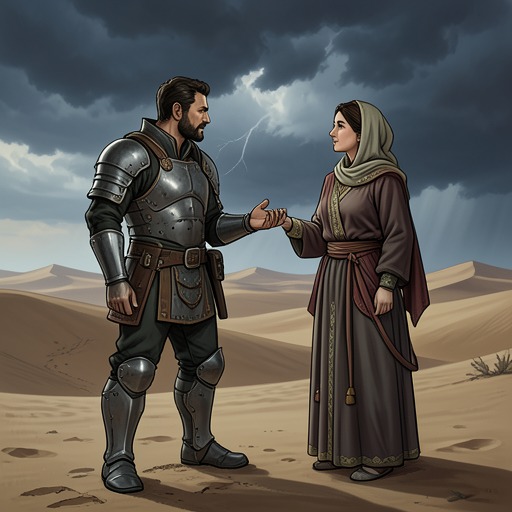
A warrior may change his metal, but not his heart
A Princess of Mars“A warrior may change his metal, but not his heart” is a Barsoomian saying about the difference between outward allegiance and inward loyalty. Dejah Thoris invokes it to reassure John Carter that joining the Thark community has not changed the friendship between them: a warrior may take up a different position among others without surrendering the loyalties that define him.
Meaning and Use
The saying is spoken during a private conversation between John Carter and Dejah Thoris. After Dejah Thoris laughs at Carter’s charge that Sarkoja is a liar, she tells him she had expected that even as a member of the community he would remain her friend. The proverb gives that confidence a concise form: social belonging can change, but the heart need not follow.
Its image of changing “metal” suggests a warrior’s equipment or allegiance as something alterable, while the heart stands for a more enduring personal commitment. The contrast makes the expression especially apt for Carter, whose place among the Tharks has changed without erasing his attachment to Dejah Thoris.
Dramatic Context
The line also counters an effort to keep the pair apart. Dejah Thoris says that whenever Carter was off duty, one of the older women in Tars Tarkas’s retinue found an excuse to remove her and Sola from sight. She describes being sent to the pits beneath the buildings to help mix radium powder and manufacture projectiles. Their separation is therefore not merely a matter of changed social roles: the community’s arrangements actively restrict their opportunities to meet.
Against that pressure, the proverb states a bond that has survived despite enforced distance. Dejah Thoris’s confidence is not based on constant contact; she names Carter’s continuing friendship as something she knew would persist even after he became part of the community. The expression turns that assurance into a principle of constancy amid political and social change.
Narrative Significance
The saying compresses a contrast central to the exchange: Carter can be incorporated into Thark society without becoming indifferent to the person from whom that society is trying to separate him. Its force lies in treating loyalty not as a fixed public status, but as a choice that can endure a change in status and circumstance. In this scene, Dejah Thoris uses the proverb both to recognize Carter’s changed position and to affirm what, in her view, has not changed between them.